Finding the best technical assessment software for HR teams isn’t about finding the platform with the longest feature list. It’s about finding the platform that helps you identify real skills quickly, fairly, and consistently.
The challenge for recruiting and talent acquisition teams is separating signal from noise. A candidate may have an impressive resume or perform well in a traditional interview, but that doesn’t always predict success in the role. The best technical assessment tools help teams evaluate how candidates solve problems, write code, collaborate, and use modern developer workflows in environments that reflect real work.
In this post, we compare 7 leading technical skills assessment platforms used for technical hiring in 2026. We evaluate each platform based on:
- Technical assessment quality and skill signal
- Coverage across different technical roles
- Live coding and collaborative interview capabilities
- AI-assisted evaluation and candidate workflows
- Security, proctoring, and fraud prevention controls
- ATS integrations and workflow efficiency
- Candidate experience and completion rates
- Pricing transparency and scalability
Whether you’re hiring software engineers, data professionals, QA specialists, or DevOps talent, the right technical assessment tool can help your team reduce time-to-hire, improve hiring confidence, and create a more consistent candidate experience.
Quick comparison: Best technical assessment software for HR teams
| Platform | Best for | AI depth | Live coding | Proctoring | ATS integration |
| CoderPad | End-to-end high-signal, realistic technical hiring for all levels | High – native AI in every product | Yes — full VS Code IDE | Real-time, instant results | Yes |
| HackerRank | High-volume junior screening | Add-on (separate purchase) | Yes | Add-on | Yes |
| CodeSignal | Flight simulator-style take-home projects | Branded chatbot only | Yes | 1+ hour delay | Yes |
| Codility | Algorithmic coding tests for early-stage filtering | Yes – Limited | Limited | Yes | Yes |
| HireVue | AI video interviewing | Medium — behavioral focus | No | Basic | Yes |
| TestGorilla | Budget-friendly pre-employment screening | Medium | No | AI-assisted | Limited |
| HackerEarth | Mid-market technical assessments | Code + AI interview | Yes | Yes | Enterprise plans |
1. CoderPad — Best overall technical assessment platform for HR teams
Best for: Talent acquisition leaders and engineering organizations looking for a single, high-signal platform for realistic technical screening, AI skills assessment, and collaborative interviews.
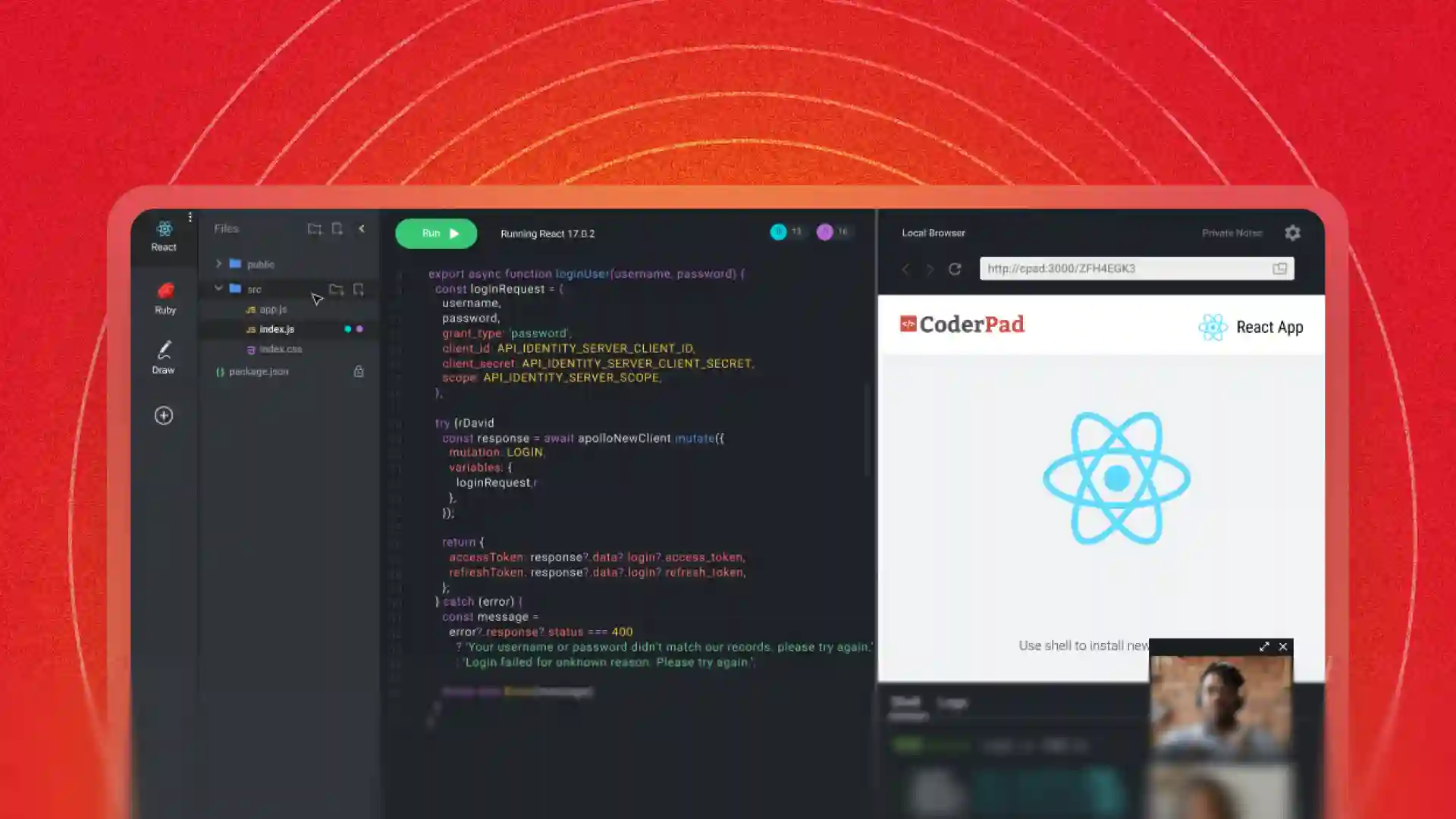
CoderPad helps teams assess modern, real-world engineering skills throughout the hiring process. Instead of relying on abstract coding puzzles or resume screening alone, teams can evaluate candidates through realistic, practical tasks, structured assessments, and collaborative coding projects that mirror the work engineers do every day.
More than 4,000 organizations, including Meta, Spotify, and McAfee, use CoderPad to streamline technical hiring while improving the quality of hiring decisions. The platform combines AI-assisted screening, realistic coding assessments, and developer-friendly interview environments in a single workflow. This allows recruiting teams to move faster while giving engineering teams better hiring signal.
What makes CoderPad different?
A technical assessment tool should measure skills, not proxies for skills.
A proven leader in AI-era hiring. CoderPad has run more than 60,000 AI-enabled interviews. Real-world scale that informs a suite of AI capabilities spanning assessment creation, candidate evaluation, live interviewing, and AI fluency testing for non-technical roles.
CoderPad brings deep AI fluency expertise to that measurement, with more than 60,000 AI-enabled interviews run on the platform — real-world scale that informs how the platform evolves.
Qualify: AI-assisted candidate screening
CoderPad Qualify helps recruiting teams review large candidate pools more efficiently through asynchronous video and written responses evaluated against custom criteria.
Candidates complete the process on their own schedule, while AI helps surface the most relevant responses for recruiter review. The result is a faster, more scalable screening process that keeps humans in control of hiring decisions while reducing administrative workload.
Teams using Qualify report screening candidates up to 90% faster compared with traditional phone-screen workflows.
CoderPad Screen: Real-world technical assessments
CoderPad Screen allows candidates to complete hands-on projects in an environment that reflects real development work.
Rather than solving isolated coding puzzles, candidates work through realistic scenarios using the same tools and workflows they would encounter on the job. Automated grading helps recruiting teams identify qualified candidates quickly, while session replay and AI evaluation tools surface hard-to-measure signals, giving hiring teams intelligent, easy-to-access context into how candidates approached the problem, collaborated with AI tools, and worked through challenges.
CoderPad Interview — Live collaborative coding in a real IDE. Full VS Code environment: multi-file, terminal, debugger, 99+ languages, and CoderPad’s exclusive coverage of DevOps and cloud frameworks including AWS, Docker, Kubernetes, Angular, Vue, and Selenium that competitors don’t support. After every session, AI Highlights gives TA an auto-generated summary; Outline gives engineering a chapter-style interview breakdown with jump links. A 90-minute session reviewed in under 10 minutes.
AI Interview Designer — From job description to assessment in minutes. Input a job description and AI Interview Designer builds a cohesive set of role-specific take-home projects and interview questions. The result is an unlimited, fully custom question bank teams can create on their own, with minimal technical expertise or engineering time required.
Benchmark AI — Compare candidates at scale. Benchmark AI moves evaluation from pass/fail guesswork to comparative, data-backed decisions. It plots candidates against one another to reveal who actually excelled and why — especially valuable for roles where AI-assisted output looks similar across candidates and the path to a solution carries more signal than the outcome alone.
AI Interview Coach — More consistent, higher-quality live interviews. AI Interview Coach surfaces real-time nudges during live interviews — suggesting strong follow-up questions, flagging coverage gaps, and signaling when to move on. Interviewers can also ask the private AI assist chat directly for follow-up recommendations.
AI Fluency Pads — AI assessment for non-technical roles. AI Fluency Pads let teams assess how non-technical candidates (sales, CSM, marketing, ops, support, HR) work with AI in a familiar, Google-doc-style pad with embedded AI chat, real-time collaboration, and full recording and playback.
Native AI across every product. ChatGPT, Claude, Gemini, and Llama are natively available in the coding environment — no downloads, no manual installs. Ask, Edit, and Plan modes let you evaluate how candidates use AI to write, edit, and reason through code. This is the skill that matters most on the job in 2026, and most competitors can’t assess it because they don’t make AI available at all.
Fraud controls that work in real time. Copy/paste blocking, extension controls, webcam proctoring with instant results (competitors like CodeSignal take 1+ hour), timestamped suspicious activity reports, and AI-generated follow-up questions triggered at the first sign of fraud. Proctoring is included — not an add-on — and the question library rotates 4,000+ items, so questions aren’t findable online.
Pricing that doesn’t punish growth. Consumption-based credits — pay per completed assessment, not per attempt. No seat caps, no overages for candidates who start but don’t finish. HackerRank charges for attempts; CoderPad charges for completions.
Partnership model, not a license. Every CoderPad customer gets a dedicated CSM from day one — migration, ATS setup, team training, and quarterly data reviews. Not triggered by renewal.
Results: 88+ engineering hours saved per hire, 20% faster time to hire, 15% fewer bad hires, $11–24K in labor cost savings per role.
Integrations: Native one-click integrations with Greenhouse, Lever, Ashby, and Workday. One question bank, one workflow, no manual handoff between stages.
Book a demo: 20 minutes, covers the full candidate experience and ATS integration.
2. HackerRank — Best for Large-Scale Question Library Coverage
Best for: Teams running high-volume, junior, technical screening who want breadth of simple algorithmic challenge coverage across many languages.
HackerRank offers one of the largest algorithmic challenge libraries in the category. The platform is a reliable choice for early-stage filtering when volume is the primary constraint and realism is not a priority.
Key capabilities: Large pre-built question library, plagiarism detection, webcam proctoring, and a free 14-day trial for initial evaluation.
Where it falls short compared to CoderPad: AI features are an add-on, most teams defer purchase, meaning the AI assessment capability that matters most in 2026 isn’t typically included in base pricing. Questions aren’t rotated on a structured cadence, so over time they can become findable online. Proctoring, AI transcripts, and AI test generation all require separate purchase. Support is primarily transactional, not partnership-oriented. Pricing is attempt-based rather than completion-based, which creates unpredictable charges.
Best fit: Early-stage, high-volume screening at companies where engineering interview depth is handled by a separate live coding tool.
3. CodeSignal — Best for Full-Stack App Simulation Assessments
Best for: Teams that want project-based take-home assessments and don’t need a tool to support their entire hiring process.
CodeSignal’s “flight simulator” has candidates work inside a simulated full-stack app environment that can mirror job context for certain roles. The platform supports about 40 languages and includes keystroke replay and in-depth reporting for enterprise users.
Where it falls short compared to CoderPad: CodeSignal’s IDE environment is inconsistent — front-end questions aren’t representative of real work, and AI tools require manual installation during the interview rather than being natively available. The question library (~1,400 items) is significantly smaller than CoderPad’s 4,000+, and templates are described by customers as basic and difficult to configure. Proctoring results take 1+ hour — too slow to act on during a live session. There are no DevOps, cloud, or QA testing frameworks in coverage. Post-session tools are limited to video playback only: no AI-generated summaries, no structured feedback tools, no keystroke-level playback.
A critical operational gap: Cheating controls are minimal by comparison — copy/paste tracking only prevents copying the question description, with no paste tracking, no real-time alerts, no extension blocking, and no fraud summary after live interviews. Disqualification decisions rely on instinct rather than evidence.
Best fit: Teams whose primary roles are backend or full-stack engineering, where the flight simulator format adds clear value and live interview assessment depth is less critical.
4. Codility — Best for Objective Algorithmic Screening
Best for: Companies that want a focused, specialist coding test tool for early-stage developer screening, particularly for backend and infrastructure roles.
Codility has a long track record as a reliable first-pass technical screen. Its coding test library is well-regarded among developers, and the automated scoring and plagiarism detection are solid. Take-home challenges and pair programming formats provide format flexibility.
Key capabilities: Coding tests, take-home challenges, pair programming evaluation, anti-cheat controls, and reporting. Supports both asynchronous and live evaluations.
Where it fits in the funnel: First-pass screening, not full-funnel. Codility does not offer autonomous AI interviewing, adaptive questioning, or the live collaborative interview capabilities of purpose-built platforms. Think of it as a strong filter, not a complete hiring solution.
Best fit: Technical teams that want a focused, reliable code-testing tool for early screening and have a separate live interview tool for later stages.
5. HireVue — Best for AI Video Interviewing at Enterprise Scale
Best for: Large enterprises running structured behavioral evaluation across high volumes of technical and non-technical roles simultaneously.
HireVue is one of the most widely deployed AI interview platforms in enterprise HR, with strong one-way video interviewing infrastructure and AI-scoring frameworks built for behavioral evaluation at scale.
Key capabilities: AI-scored video interviews using structured behavioral frameworks, game-based cognitive assessments, conversational AI scheduling, and basic coding assessments.
Important consideration for 2026: HireVue’s AI hiring tools have faced active litigation for age, disability, and accent-based discrimination. NYC Local Law 144 now mandates annual third-party bias audits for any AI hiring tool — verify compliance documentation before procurement for any NYC hiring.
Where it falls short for technical hiring: Coding assessment depth doesn’t match platforms built exclusively for developer evaluation. One-way video formats report higher candidate drop-off rates, particularly among senior engineers. The platform is designed for volume behavioral screening, not engineering fidelity.
Best fit: Large enterprises where behavioral evaluation at scale is the primary use case, and coding assessment is a secondary requirement handled by a separate vendor.
6. TestGorilla — Best Budget-Friendly Pre-Employment Screening Option
Best for: Startups and SMBs that need structured pre-employment screening across multiple role types without enterprise pricing or implementation support.
TestGorilla offers a 400+ test library spanning coding, cognitive ability, language, and personality, with fast setup and accessible pricing. AI-assisted test creation from job descriptions and screen monitoring anti-cheat features make it functional for early-stage filtering.
Key capabilities: AI-generated tests from JDs, multi-skill batch testing, proctoring controls, automated ranking, and performance analytics.
Where it fits: Top-of-funnel, high-volume filtering for roles where a baseline skill check matters more than engineering fidelity. Coding tests don’t match dedicated developer evaluation tools in rigor, and there’s no live coding interview capability.
Best fit: Teams hiring across a mix of technical and non-technical roles at scale, where early-stage filtering speed matters more than deep engineering signal.
7. HackerEarth — Best for Mid-Market Technical Assessment Breadth
Best for: Mid-market companies hiring across technical disciplines who want a single platform spanning assessments, live coding, and AI-led first-round screens.
HackerEarth covers multiple funnel stages with its assessment platform, FaceCode live coding tool, and OnScreen — its AI-led first-round interview product launched in April 2026. The platform is used by a range of global enterprises for technical recruiting.
Key capabilities: Coding assessments across 40+ languages, multi-signal proctoring, AI-led screening interviews via OnScreen, candidate ranking dashboards, and skills coverage extending to non-technical roles.
Where it fits: Credible for mid-market technical screening and AI-led first-round standardization. Enterprise ATS integration availability should be confirmed with sales for specific connectors.
Best fit: Mid-market technical hiring teams looking for a single platform with AI interview automation for first-round screening.
Key features to look for in technical assessment software
When evaluating technical assessment software for HR hiring processes, focus on the capabilities that improve hiring quality, candidate experience, and team efficiency.
AI integration that reflects modern engineering work
AI is now part of how many engineers solve problems, write code, and collaborate. The best technical skills assessment platforms make AI available within the assessment environment so teams can evaluate how candidates use these tools in practice.
Look for platforms that provide native access to leading AI models and offer visibility into how candidates interact with AI throughout the assessment process. The goal isn’t to see whether candidates use AI—it’s to understand how effectively they use it.
Real-world development environments
Developers perform best when assessments reflect the environments they use every day.
A technical assessment tool should provide a realistic IDE experience, including support for multiple files, debugging, terminals, package management, and the frameworks relevant to the role. Assessments that feel like real work tend to produce stronger hiring signal and a better candidate experience.
Fair and effective integrity controls
Assessment integrity matters, but so does candidate trust.
Look for platforms that provide real-time monitoring, configurable proctoring options, and transparent reporting without creating unnecessary friction for candidates. The best solutions help teams identify suspicious activity while maintaining a respectful assessment experience.
Structured interviewer workflows
Hiring decisions are more consistent when interviewers have access to clear evidence and shared evaluation criteria.
Features such as AI-generated summaries, transcripts, replay functionality, and structured scorecards can help interview teams review candidate performance efficiently while reducing bias and improving calibration across interviewers.
Flexible pricing and scalability
Technical hiring needs change over time. Evaluate how pricing aligns with your hiring volume, growth plans, and assessment strategy.
Consider whether pricing is based on attempts, completions, seats, or usage, and how those costs may scale as your team grows.
Native ATS integrations
Strong integrations help recruiting teams move candidates through the hiring process without manual work.
Prioritize platforms that integrate directly with the systems your team already uses, including Greenhouse, Lever, Ashby, and Workday. Native integrations often reduce administrative overhead and improve data consistency across the hiring workflow.
Candidate experience
Candidate experience is often an overlooked evaluation criterion.
A developer-friendly assessment experience can improve completion rates, strengthen employer brand perception, and help teams engage highly qualified candidates. Look for platforms that balance rigor with accessibility and provide candidates with an environment that reflects how they actually work.
How to choose the right technical assessment software for your team
The best technical assessment software for HR teams depends on where you need better hiring signal—not simply which platform has the longest feature list.
For many organizations, the biggest opportunity is improving early-stage screening. Structured technical assessments can help recruiters identify qualified candidates sooner, allowing engineering teams to spend more time with candidates who demonstrate the skills required for the role.
Use this framework when evaluating vendors:
- Define your hiring goals. Consider hiring volume, role types, and the level of technical expertise required across your open positions.
- Map your hiring workflow. Identify which stages need additional structure or automation, including sourcing, screening, assessments, interviews, or candidate communication.
- Review ATS compatibility. Verify that the platform integrates with your existing recruiting systems and supports your team’s workflow requirements.
- Test the candidate experience. Complete an assessment yourself and gather feedback from hiring managers or engineers. The environment should feel realistic, intuitive, and relevant to the role.
- Evaluate fairness and integrity controls. Ask vendors how they support assessment integrity, candidate privacy, and compliance requirements.
- Understand the AI experience. Determine how AI is incorporated into assessments, what visibility evaluators receive, and how human review remains part of the decision-making process.
- Run a pilot program. Before making a long-term commitment, test the platform with a specific role or hiring team and measure outcomes such as completion rates, assessment quality, and hiring efficiency.
The right technical assessment platform should help your team make better hiring decisions while creating a fair and positive experience for candidates.
Integration with ATS and HRIS Systems
Native integrations reduce more friction than they appear to on paper. When a platform requires manual candidate movement between stages — even one click per candidate at scale — that overhead compounds into hours of recruiter time per week.
The integrations that matter most: Greenhouse, Lever, Ashby, Workday. Beyond the basic connection, verify that integrations trigger automatic stage changes and route results without requiring manual reconciliation. Platforms that offer open APIs but no native connectors to your specific ATS will require engineering time to implement and ongoing maintenance.
Benefits of technical assessment software for HR teams
Technical assessment software can help recruiting teams move faster, but speed alone isn’t the goal. The best platforms help teams make more informed hiring decisions while creating a fair and consistent evaluation process.
Effective technical hiring platforms typically deliver value in three ways:
- Help recruiters identify qualified candidates earlier in the process
- Give hiring managers stronger evidence of real-world skills
- Reduce time spent on interviews that are unlikely to lead to successful hires
For organizations hiring engineers, technical assessments provide an opportunity to focus on demonstrated ability rather than résumé signals alone. This approach can improve consistency, support more inclusive hiring practices, and create a better experience for both candidates and interviewers.
CoderPad customers report measurable hiring outcomes, including 88+ engineering hours saved per hire, 20% faster time-to-hire, and $11K–$24K in labor cost savings per role. As always, results vary based on hiring volume, role complexity, and process design.
If you’re evaluating technical assessment software for HR teams, focus on platforms that help you assess real-world skills, support structured decision-making, and integrate seamlessly into your existing hiring process.
Frequently Asked Questions
-
CoderPad is the strongest end-to-end option for HR teams hiring software engineers in 2026, particularly teams that want a single platform spanning AI-powered resume screening (Qualify), async take-home assessments (CoderPad Screen), and live collaborative coding interviews (CoderPad Interview). For teams that need only a question library for early-stage filtering, HackerRank offers the broadest algorithmic challenge coverage.
-
A technical assessment tool is specialized software that enables employers to objectively evaluate candidates’ programming skills using automated coding challenges, realistic development environments, and analytics — as opposed to resume reviews or behavioral interviews that infer technical ability rather than measure it directly.
-
Pricing varies significantly by vendor and usage model. Entry-level plans typically start around $99/month for limited volume; enterprise pricing is custom. CoderPad uses consumption-based credits — pay per completed assessment, with no seat caps — which reduces unexpected costs at scale. HackerRank charges per attempt, which can create billing surprises when candidates start but don’t finish.
-
Candidate ease of use varies more than vendor marketing suggests. Completion rate is the clearest proxy: platforms where senior engineers drop out mid-assessment are signaling a friction problem. CoderPad reports 60% higher completion rates and 97% candidate preference among engineers, driven by environment quality — the assessment feels like real work rather than a test.
-
Fair technical evaluation requires three elements working together: consistent criteria (standardized rubrics applied to every candidate, not interviewer impressions), realistic assessment environments (candidates assessed on work similar to what the role requires, not abstract puzzles), and bias-reducing controls (anonymized scoring views, structured feedback, and — for regulated jurisdictions — bias audit documentation from the vendor).
-
Native AI availability in the coding environment is the critical differentiator in 2026. Platforms that restrict AI access during assessments are testing for 2019-era engineering skills. Look for: native access to ChatGPT, Claude, and Gemini without manual installation; the ability to see what AI the candidate used and how; and AI modes (Ask, Edit, Plan) that let you evaluate how candidates reason with AI, not just whether they can produce code.
-
The clearest comparison axis is where each platform performs in the funnel and what they include in base pricing. CoderPad includes AI, proctoring, and a CSM natively; HackerRank and CodeSignal treat these as add-ons. CoderPad’s question library (4,000+) is 3x larger than CodeSignal’s (~1,400). HackerRank has the broadest algorithmic challenge library for early-stage filtering. CodeSignal’s flight simulator format is differentiated for full-stack take-homes but has significant IDE and fraud detection limitations for live interviews.
See the CoderPad vs. HackerRank and CoderPad vs. CodeSignal comparison pages for full feature-by-feature breakdowns.