AI has fundamentally changed how engineers work.
It’s not a tool candidates might use anymore. It’s embedded in how code gets written, reviewed, and shipped every day. In many teams, the majority of code is already AI-assisted—and growing.
Which leads to a clear conclusion for hiring teams:
Interviews without AI interviews are becoming obsolete.
Trying to remove AI from the interview process doesn’t restore signal—it distorts it. The companies making the best hiring decisions right now aren’t avoiding AI. They’re designing processes that work with it.
That’s what defined the first 5 months at CoderPad.
We focused on helping teams generate better signal in an AI-native world—by making interviews more realistic, candidate behavior more observable, and evaluation more structured.
AI-Native Interviews, Not AI-Restricted Ones
The biggest shift was making AI a first-class part of technical evaluation.
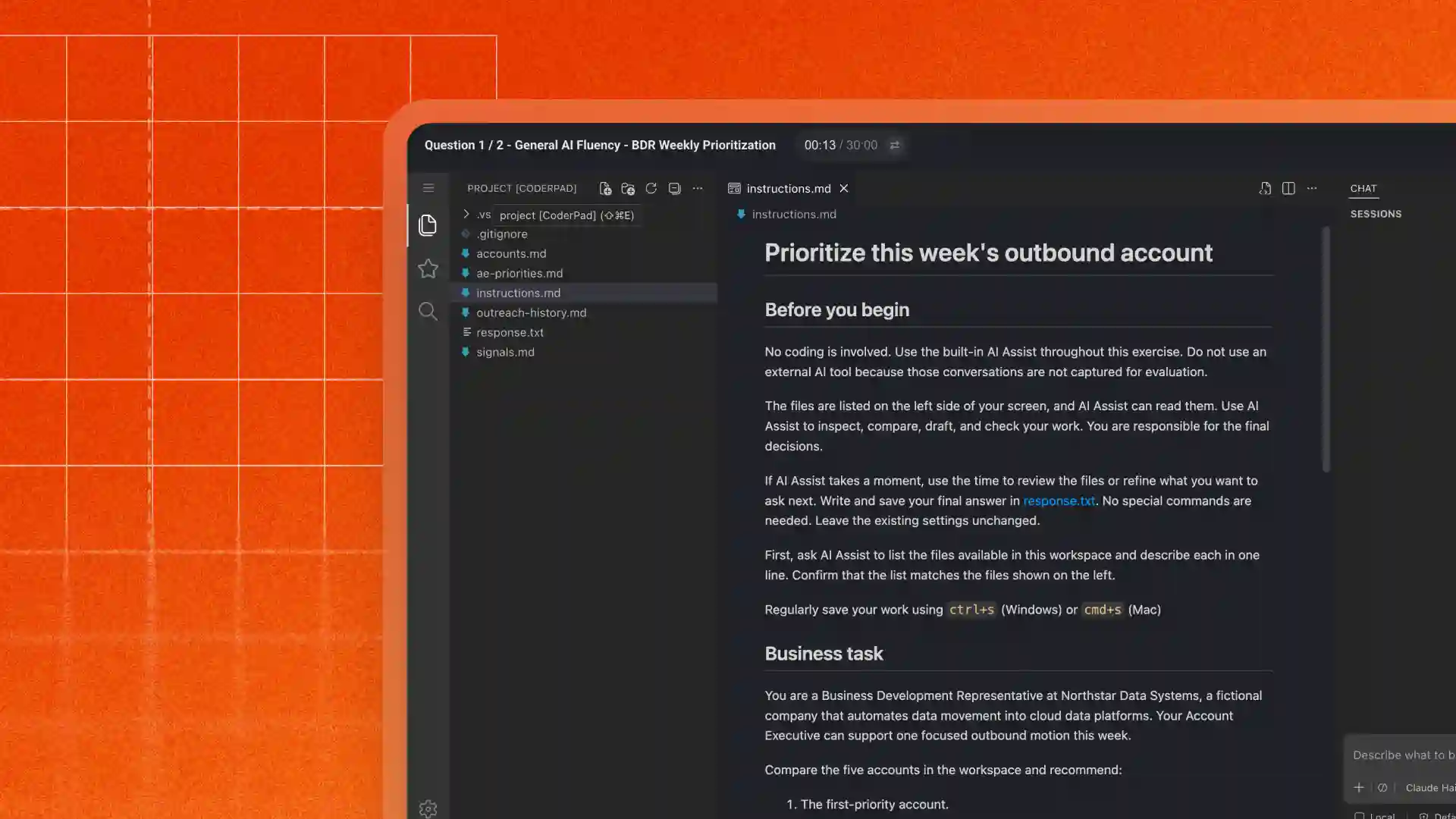
With AI Assist Edit Mode in both Screen and Interview, candidates can now use AI to directly write and modify code—not just chat questions. This mirrors how modern engineers work with tools like Cursor and Copilot.
In Interview, we extended this further with Plan Mode, allowing candidates to collaborate with AI before writing code—laying out their approach, reasoning through tradeoffs, and making decisions visible.
This changes what you evaluate.
Instead of measuring whether a candidate can produce code unaided, you can assess:
- How they guide AI
- How they validate outputs
- How they reason through problems
- How they move from idea → implementation
We also upgraded AI Assist to the latest frontier models (Claude, GPT, Gemini), ensuring candidates and interviewers are working with tools that reflect real-world environments.
The Top of Funnel Got Rebuilt
AI didn’t just change interviews—it broke traditional screening.
Resume screens, trivia questions, and generic MCQs no longer produce reliable signals. High-performing teams are shifting toward realistic, role-aligned evaluation earlier in the funnel.
This quarter, we expanded CoderPad Screen Projects to support that shift:
- Real-world, multi-file environments
- Run tests with a single click
- Full diff view of candidate changes
- Faster iteration on project setup
At the same time, Video Questions became available to all customers —giving teams a way to evaluate communication, reasoning, and clarity asynchronously.
This shifts the hiring model. Teams can replace phone screens with async Video Questions, introduce Projects earlier to get real signal, and cut down on low-value live interviews. The outcome is what you’d expect: fewer weak interviews, stronger candidate differentiation, and less engineering time spent on the wrong candidates.
Integrity in the Age of AI
As AI makes it easier to generate code, the challenge isn’t preventing AI usage—it’s understanding behavior.
We expanded integrity signals across Screen and Interview:
- Concurrent session prevention to close session-sharing loopholes
- Paste detection in Project playback for multi-file environments
- “Copied all code” alerts in live interviews
- Extension controls to manage candidate tooling
These aren’t about chasing endless loopholes in candidate behavior—they’re about giving reviewers the context they need to interpret what happened in the session.
In an AI-assisted workflow, signal comes from how candidates work, not just what they produce.
Structured Evaluation That Scales
Better signal only matters if it leads to better decisions. That’s why we continued investing in structured evaluation across the platform.
With Interview Rubrics, teams can anchor feedback to predefined criteria directly inside the Interview pad—reducing inconsistency and improving calibration across interviewers.
With Interview Outlines, every session now generates a structured summary—independent of transcription—making it easier to dig deeper into sections of the interview.
We also expanded integrations and workflows:
- Ashby integration improvements
- Candidate feedback visibility for admins
- Admin tooling for user management and communication
Together, these changes move CoderPad beyond a point solution toward a system of record for technical evaluation.
What This Adds Up To
These past months weren’t about adding more features, it was about helping CoderPad’s customers adjust to a reality that’s already here:
- AI is how engineers work
- Signal must be generated earlier
- Evaluation must be structured and observable
The teams leaning into this shift are already seeing it play out—fewer wasted interviews, stronger candidates, and more confidence in hiring decisions.
What’s Next
If our latest releases were about bringing AI into every workflow, the next phase is focused on tools to help you better run AI-enabled interviews. We’re launching a full suite of features that will help turn guesswork into data that supports even better decisions.
We’re continuing to invest in helping teams not just run interviews—but understand them.
More soon.