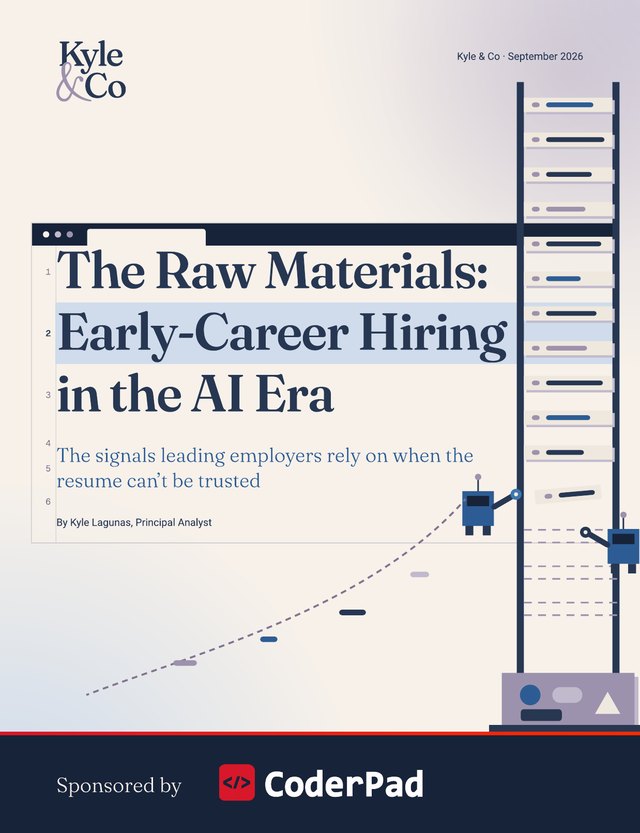
New research Early-career hiring in the AI era
Hiring for potential: how the best teams find tomorrow’s talent
AI can write a strong resume, cover letter or take-home in seconds, so it’s harder than ever to tell who can actually do the job. Kyle & Co and CoderPad surveyed 271 HR and TA leaders to find out what still works.
You’ll learn
- Which hiring methods still show real potential
- The one practice that sets top employers apart
- Why telling candidates your AI rules makes resumes useful again
- Six steps to improve early-career hiring, easiest first
Get your free copy
Instant access.
Free PDF download
- HR & TA leaders surveyed
- 271
- Seniority range
- Manager to CHRO
- Employees per company
- 50 to 50,000+
- Talent leaders interviewed
- Lyft & Box
By the numbers
What 271 hiring leaders told us
Employers know what makes a great early-career hire. Their hiring process hasn’t caught up.
-
Employers value judgment, but don’t screen for it.
87% value skill and judgment over AI fluency
Rank in what they screen for
Of nine qualities employers screen early-career candidates for, judgment comes last.
-
Clear AI rules double the resume’s signal.
25%No guidance54%Clear rulesShare of employers who say the resume gives them “a lot” of signal.
-
Employers hire for potential, but screen with the past.
7 in 10 Screen with the resume
2 in 5 Get real signal
More than half of what employers screen for is potential, yet the resume is the first tool they reach for.
Get the full data Every chart and breakdown is in the free report.
How do we hire for potential and slope? People who can adapt in a new environment and grow with it, and have agency to move and change quickly.
Almost everyone’s going to have a pretty high score on the take-home portion. The live interview is definitely the biggest indicator of how well they really do.
What’s inside
Six findings on early-career hiring
What’s working, what isn’t, and what the employers getting the best early-career hires do differently.
-
01 The fear
The top AI worry hasn’t changed how teams hire
Employers fear a workforce that can’t adapt to AI. They still screen the way they always have.
-
02 Potential
Hiring for the future with tools about the past
Employers say they want potential, but most of their tools measure history.
-
03 Early career
Early-career is where process matters most
With little work history to go on, quality of hire depends on how well your process tests what candidates can do.
-
04 New skills
Almost no one tests what’s new
The two skills AI made newly important are the two employers assess least.
-
05 AI rules
Unclear AI rules, not AI, weakened the resume
The cheapest fix in the report: tell candidates what AI use is allowed.
-
06 Observation
Employers who watch candidates work are ahead
The more observed methods an employer uses, the more likely it is to rate itself ahead on quality of hire.
Plus: the playbook
Six practical steps to close the gap, easiest first.
About the research
A research partnership between Kyle & Co and CoderPad

About Kyle & Co: A modern research and advisory firm helping HR and talent technology leaders make smarter decisions, faster.
- Method
- Survey + practitioner interviews
- Interviews conducted by Kyle & Co
- Seniority
- 3 in 5+ director level or above
- All involved in early-career hiring
- Data quality
- Screened responses
- Attention checks, fraud traps and plausibility checks
- Analysis
- Independent, by Kyle & Co
- Conclusions are Kyle & Co’s alone
Hire for potential, with proof
Six findings and a six-step playbook from 271 HR and TA leaders.
Free · instant access