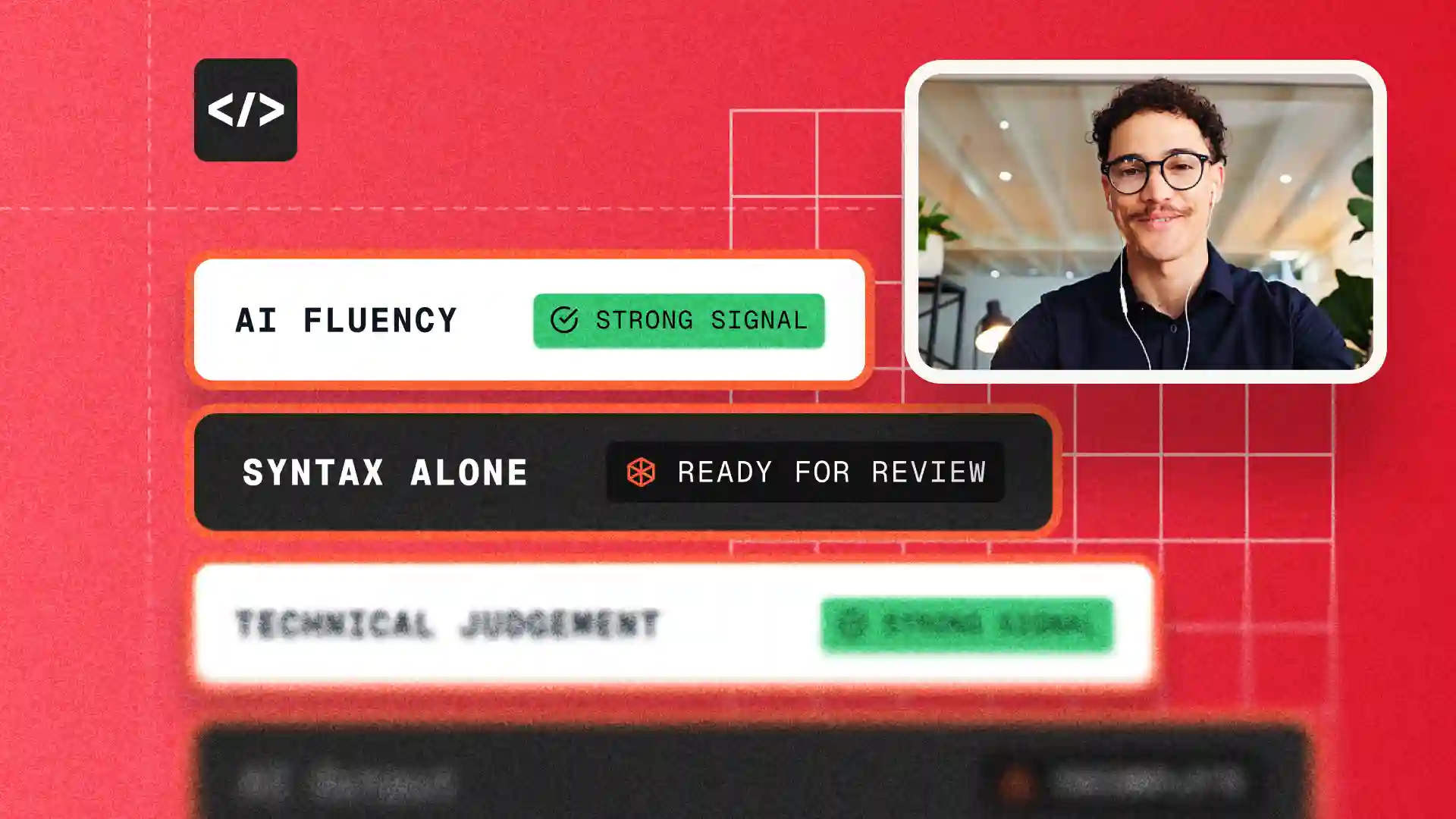
Artificial intelligence has fundamentally changed software development.
Developers are no longer working in isolation, writing every line of code from memory. AI has become part of the engineering workflow, helping developers brainstorm approaches, generate boilerplate code, and debug complex issues. The question isn’t whether engineers are using AI. It’s how effectively they’re using it.
Hiring teams now face the same reality.
For years, technical interviews were designed to answer a relatively straightforward question: Can this candidate write code?
Today, that question is incomplete.
Modern engineering requires developers to collaborate with AI while applying technical judgment, critical thinking, and problem solving. The strongest engineers know when to trust AI, when to challenge it, and when to ignore it altogether.
The real question now is not “Can this candidate write code?” it is “can this candidate think critically? Can they think beyond the tools?” That also means hiring teams must evolve the way they evaluate talent.
AI Is No Longer Optional
The data tells the story.
CoderPad’s 2026 State of Tech Hiring Report found that 82% of developers say generative AI is useful in their day to day work, while 54% say their productivity would decrease if AI tools disappeared tomorrow.
For many engineering teams, AI has already become as commonplace as version control or an IDE.
Yet many hiring processes still ask candidates to interview in environments that look nothing like the way they’ll actually work.
Candidates are expected to solve problems without AI, even though they’ll be using AI every day once they’re hired.
That disconnect creates a growing skills gap between what companies assess and what success on the job actually looks like.
Measuring Engineering Judgment, Not AI Output
One of the biggest misconceptions surrounding AI enabled interviews is that allowing AI somehow makes interviewing easier.
In reality, it raises the bar.
When AI can generate code in seconds, interviewers need to evaluate something much more valuable than syntax.
They’re evaluating judgment.
Can a candidate recognize when AI produces incorrect or incomplete solutions? Do they validate outputs before accepting them? Can they explain why they chose one approach over another? How do they adapt when requirements change or edge cases emerge?
These behaviors reveal engineering maturity in ways traditional coding exercises never could.
AI fluency isn’t about prompt engineering.
It’s about knowing how to collaborate with AI while maintaining ownership of the solution.
What We’ve Learned from 60,000 AI Enabled Interviews
At CoderPad, we’ve had a unique opportunity to watch this shift unfold in real time.
Our platform has powered more than 4 million technical interviews for over 4,000 organizations, including Meta, OpenAI, Spotify, LinkedIn, Goldman Sachs, Shopify, and Snowflake. More recently, we’ve helped customers conduct more than 60,000 AI enabled interviews, giving us unparalleled visibility into how organizations are adapting technical hiring for the AI era.
Across those interviews, one pattern has become increasingly clear.
The companies making the fastest progress aren’t simply turning AI on during interviews.
They’re redesigning their whole hiring process around AI fluency.
That starts with creating interview environments that mirror real engineering work. Instead of relying on isolated coding exercises, they’re evaluating candidates in realistic development environments where AI is available, just as it would be on the job.
It also means asking different questions.
Rather than focusing solely on arriving at the correct answer, interviewers observe how candidates interact with AI throughout the problem solving process. They evaluate how candidates frame prompts, validate outputs, identify flaws, reason through tradeoffs, and iterate toward better solutions.
Those observations provide significantly stronger hiring signals than whether a candidate produced working code alone.
AI Fluency Starts with the Interview Platform
Modernizing technical interviews requires more than allowing candidates to open ChatGPT in another browser tab.
Hiring teams need interview environments purpose built for AI enabled assessments.
That’s where CoderPad comes in.
CoderPad enables organizations to recreate the modern software development experience inside the interview. Candidates can work with AI tools in a controlled environment while interviewers observe how they collaborate with those tools in real time.
Interviewers aren’t left guessing whether AI was used or how much of the solution was generated independently. Instead, they can evaluate the behaviors that matter most: reasoning, validation, debugging, workflow decisions, communication, and engineering judgment.
The platform also helps organizations become more AI proficient internally.
As hiring teams begin adopting AI enabled interviews, many face practical challenges. What questions should we ask? How do we score AI fluency? How do we ensure consistency across interviewers? How do we prepare candidates? What skills should we actually measure?
CoderPad helps answer those questions by providing structured interview frameworks, AI aware evaluation rubrics, interviewer guidance, and best practices developed from thousands of real world interviews. Instead of asking every hiring team to reinvent their interview process, organizations can adopt proven approaches that evolve alongside AI itself.
In other words, CoderPad doesn’t just help companies assess AI fluency. It helps them build it.
How AI Ready Is Your Hiring Process?
Every hiring team is somewhere on the AI maturity curve.
Some organizations are still debating whether candidates should use AI at all. Others have begun experimenting with AI-enabled interviews but aren’t confident they’re measuring the right skills. The most mature organizations have redesigned their interview process around AI fluency, evaluating not just technical ability, but how candidates collaborate with AI, validate its outputs, and apply engineering judgment.
Where does your team stand?
To help organizations answer that question, we’ve created a free AI Era Readiness Assessment. In just a few minutes, you’ll benchmark your hiring process across six critical dimensions of AI era hiring, including interview environments, question design, evaluation frameworks, interviewer readiness, and AI adoption.
Once you’ve completed the assessment, our team can walk through your results with you in a complimentary AI hiring audit. Together, we’ll review where your process is strong, identify opportunities to better assess AI fluency, and share practical recommendations based on what we’ve learned from more than 60,000 AI enabled interviews.
The future of technical hiring isn’t about keeping AI out of the interview. It’s about building a hiring process that reflects how great engineers actually work.