New white paper For engineering leaders
One brain, many hands: hiring for the orchestration era
The biggest AI results of 2026 came from one model orchestrating hundreds of agents, not from one clever prompt. This short white paper explains how that work gets done, why most engineering teams are not there yet, and how to hire engineers who already work this way.
You’ll learn
- How 2026’s biggest AI results were actually produced
- The 4 moves of orchestration: decompose, parallelize, verify, persist
- A 5-level AI Fluency Ladder to place every engineer
- How to run a 30-minute agentic interview
- Agents that built an operating system
- 1,000+
- From empty folder to a bootable OS
- 8 days
- To formalize Fermat’s Last Theorem
- 30 hours
- On the AI Fluency Ladder
- 5 levels
What’s inside
From frontier AI results to your next engineering hire
Six short sections for CTOs and engineering leaders deciding how their teams build, and who they hire next.
-
01 Proof
AI just built an operating system
7 results from 2026, from a bootable OS to formal proofs, and how each one was produced.
-
02 Method
Orchestration, not one-shot magic
Decompose, parallelize, verify, persist: the loop behind every result, and why it scales down to one engineer.
-
03 The gap
Your team has the models, not the habits
Why the gap is in training, approvals and process, not in access to AI.
-
04 Stakes
Competitors and attackers move at agent speed
A lead in distribution buys time, not immunity. Fixes now have to ship at agent speed too.
-
05 Framework
The AI Fluency Ladder
5 levels, from no AI to orchestrating a team of agents. Levels 4 and 5 are agentic engineering.
-
06 Hiring
A 30-minute agentic interview
Set a real application to build, require AI, and score both the outcome and the ladder level.
Sources include Anthropic’s Claude Fable 5.2 release (November 9, 2026) and its write-up on building a C compiler with parallel agents (February 5, 2026). The PDF lists every source.
The AI Fluency Ladder
Which level do your engineers work at?
The ladder describes how a candidate works with AI, from not at all to directing a team of agents. Score the level they work at for most of a hands-on session.
Levels 4 and 5 are agentic engineering.
-
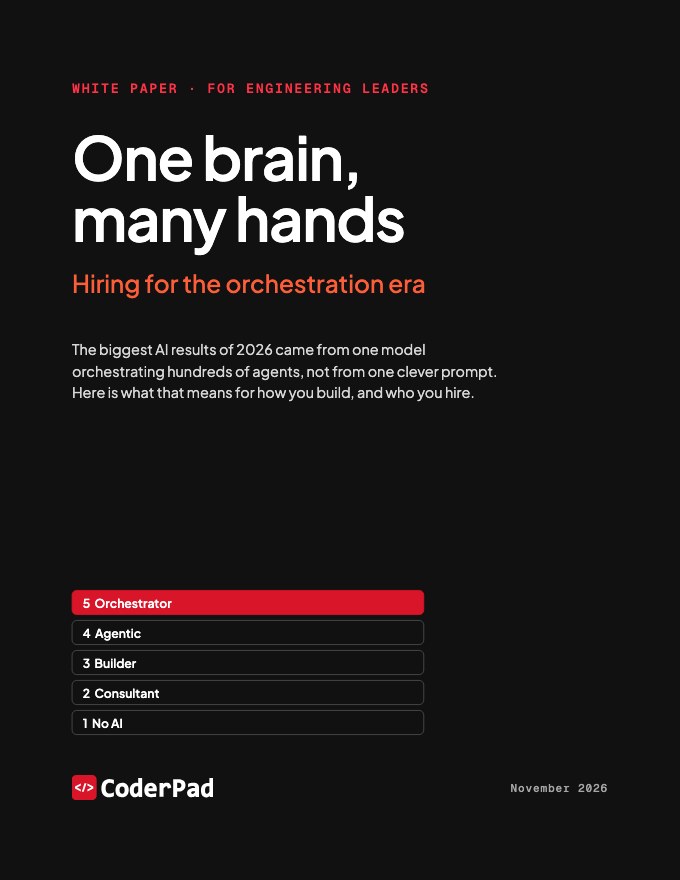
Level 5: Orchestrator AI is a team
Runs several agents in parallel and has them check each other’s work.
-
Level 4: Agentic AI is a teammate
Plans with AI first, then delegates real work to an agent and iterates.
-
Level 3: Builder AI is a typist
Asks AI for big chunks of code, then copies and stitches them by hand.
-
Level 2: Consultant AI is an advisor
Uses AI like a better search engine: asks, reads, light autocomplete.
-
Level 1: No AI AI is absent
Solves everything by hand.
Put it in your interview
Stop testing what AI solves in one second
A classic algorithm puzzle tells you little about how an engineer works in 2026. An agentic interview shows you the actual skill.
Tell every candidate in advance that AI is expected, and give everyone the same environment. You screen in strong builders from any background, and people make every hiring decision.
- Time
- 30 minutes
- More scope than anyone could finish by hand
- Task
- Build a real application
- Several features and a bug to find
- AI
- Required
- Several agents at once are welcome
- Score
- Outcome and ladder level
- Working features, code quality and tests
Interview the way engineers work now
The results, the method, the ladder and the interview design, in 5 pages.
Free · no form